
1. The most liveable cities of the future aren’t the most efficient ones — they’re the ones that ask better questions
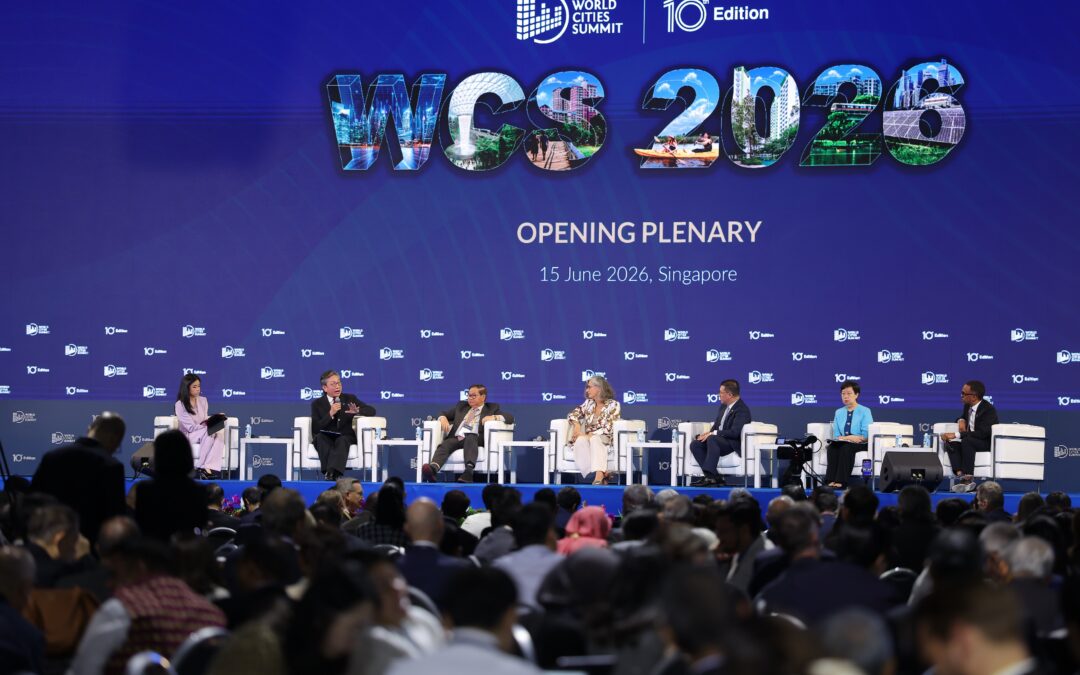
Singapore’s Prime Minister Lawrence Wong opened the Summit with a sober diagnosis: the world is polarising, technology is raising anxieties, and familiar ways of living are changing faster than consensus can form. Cities, he said, sit at the frontlines of humanity’s biggest challenges — but are also our best hope for solutions, ideal testbeds for developing, testing and scaling what works.
Particularly striking was his framing of Singapore’s own story: never driven by ideology, but by pragmatism. Testing what works. Drawing conclusions. Learning. Such a simple, that almost radical approach to urban governance.
And yet, the Summit’s most memorable voices kept redirecting attention away from efficiency and towards something harder to measure. Professor Lily Kong of SMU called for moving from “procurement to purpose”. Former Mayor of Melbourne Sally Capp, and the Mayor of Bucharest Ciprian Ciuciu, agreed that a city’s success should be measured not so much in infrastructure delivered but in belonging generated. Professor Yeo Siew Haip of NUS put it most starkly: if there were one metric to choose, ask whether the people who were there before still stay there today.
The question cities of the future need to ask isn’t how efficient are we? It’s who do we belong to, and who belongs here?
2. Humans must stay at the heart of the city — especially as AI takes centre stage
The Science of Cities Symposium set the tone with what became a recurring theme throughout all three days: even as AI-driven technologies permeate urban research and planning, the call to keep humans at the heart of urban development was unanimous.
Google DeepMind’s Ramine Tinati outlined five pillars of AI for smart cities — Design, Navigate, Work, Play, Live — and framed AI as a tool for imagining cities before they are built, where designers, architects, and citizens co-create possibilities together. Arup’s David Moran was blunter: 56% of cities globally are already using AI, and those with good planning data and internet access will have a privilege. What about those who don’t?
The risk is real. As Anacláudia Rossbach from UN-Habitat reminded the audience: let’s not replace processes. Data might not be there for everyone. Human rights frameworks exist for a reason. And when Bowen Zhou from SUSS showed how social media analysis can surface bottom-up perceptions and place-based narratives — the lived experiences that official data often misses — it was a reminder that the gap between what cities measure and what residents actually feel remains wide.
Technology can be an extraordinary tool for participation and co-creation. But community-centred design and evaluation, with real human contact, must remain at the core.
3. From smart cities to regenerative cities of the future: the shift is underway
Thomas Schroepfer of SUTD articulated what felt like the defining conceptual shift of the Summit: the move from mitigation to transformation. Cities that not only consume resources, but contribute. Cities that not only preserve ecology, but strengthen it.
This is not only a technological challenge. It is, fundamentally, a design challenge — and a social one. As Schroepfer put it, whether people feel comfortable outdoors shapes how they work, live, and interact. The task is not optimisation. It is integration.
Sam Hayes of Bioneering Australia took this further with the concept of Ecological Performance Standards: a framework that asks what would nature do best? Humans are, she reminded attendees, the ultimate biological sensors. And Louise Vogel Kielgast of Gehl shared research on Urban Belonging, working with seven self-declared minority groups to map where different communities felt a sense of belonging — and where they didn’t. It is interesting to note that the word “belonging” itself meant something different to every group.
4. The hyperlocal shift is one of the most exciting urban planning movements
Day 3 opened with a session that could have filled the entire Summit. Carlos Moreno, the architect of the 15-minute city concept, walked through how Paris built its new master plan around it — and crucially, why citizen participation, not just policy, made it work. The concept is not tactical urbanism, he insisted. It is strategic urbanism, built on three pillars: governance, design, and citizen participation.
What followed was a series of extraordinary case studies. Seoul’s 100-year vision of 150 micro-cities within one resilient city, built block by block through public hearings and town halls. US cities like Portland, Atlanta, and Fairfield rethinking their zoning, planning for ageing, and seeing property values rise along the way. Bogotá’s neighbourhood revitalisation model, which created an Urban Revitalisation Index measuring habitat, functionality, and sustainability. And Copenhagen’s transformation, guided by six principles — starting with people and social infrastructure first, always.
The questions that linger are the right ones: What about different opinions? Not everyone wants to live where they work. How do we ensure the hyperlocal shift doesn’t create communities that are closed, disconnected, and exclusive?
While the promise of hyperlocalism is immense, the risks are worth naming.
5. Tooling for cities: build modular, open, and for people (but not just experts)
The Science of Cities Symposium featured an extraordinary panel of researchers building digital tools for urban planning, and the lessons were as practical as they were principled.
Among them, Peter Herthogs of NUS made the point that many of the tools being built are expert tools — useful for researchers and planners, but not for citizens or policymakers. The real challenge is to distil and condense scientific insights into common-sense interactions. Kelvin Li from URA added that it is never really about the tooling — it is about whether the tools can help answer policy questions, and whether users can be trained to use them effectively.
Jörg Rainer Noennig of HCU Hamburg, showcased three tools that brought this to life: the Resilience Checker, the Urban Trend Radar, and the Simulation Cockpit, a 3D built environment digital twin that brings multiple simulators together. Ivan Beliaev of SUTD offered a more philosophical framing: analysis isn’t a decision. The problem was never intelligence. It was accountable choice — and AI must stay faithful to the decision-maker, even in disagreement.
Three principles for urban tooling emerge from these discussions: build on existing tools; build in a modular, expandable way; and make open source a default, not an afterthought.
6. The Lee Kuan Yew World City Prize: London, and what we can learn from all finalists
Cities of the future were celebrated at the Summit. London was awarded the 2026 Lee Kuan Yew World City Prize — a well-deserved recognition of a remarkable urban transformation. Mayor of London Sir Sadiq Khan traced the journey: from the Elizabeth Line to the world’s first Ultra Low Emission Zone, from free school meals to beavers born in London for the first time in 400 years. Behind every step, there was a decision and a mission of building a fairer, greener, safer, and more prosperous city for everyone.
But the special mentions were, in some ways, even more instructive. Antwerp’s Ring Parks — one of Europe’s largest transformation projects — are reconnecting neighbourhoods separated for decades, with climate action fully integrated into overall development rather than treated as a separate policy. Budapest, facing chronic resource constraints, turned limitation into innovation: pop-up urbanism, a restored chain bridge that became a piece of the city’s soul, rethinking historical parks as biodiverse urban forests. Taipei distributed fresh milk to schoolchildren through convenience stores, turning an existing network into resilience infrastructure. Guangzhou built co-creation committees and heritage guardians as mechanisms for inclusive urban development.
Each of these cities is doing something difficult to capture in any index: building civic identity alongside physical infrastructure.
7. Citizen-led change is where the most transformative work is happening
The session on transforming urban change by and for citizens, featuring the WRI Ross Center Prize for Cities, stood out as one of the Summit’s most powerful moments.
RISE (Revitalising Informal Settlements and Environments), led by Diego Ramirez-Lovering of Monash University, is filling the gap between large-scale sanitation infrastructure and household-level WASH solutions in informal settlements in Makassar, Indonesia. It is a consortium of 170 people from 25 organisations, using rigorous randomised controlled trials for evidence building. This is what truly people-centred urban research looks like.
The Move As One Coalition, a movement of 177,000 people and more than 140 organisations in the Philippines, is fighting for safer, more humane transport through a simple yet powerful approach: solidarity. The presentation featured the individual heroes of this coalition and the ways they show up for one another. It was, quite simply, moving.
Both presentations were a reminder that the most transformative urban change is rarely led by governments or corporations alone. It is led by people who refuse to accept the city as it is, striving for better quality of life for everyone.
8. City indices: a call to think, not a verdict
The final session brought together the organisations behind some of the world’s leading city indices — Arup’s City Competitiveness Index, Resonance’s World’s Best Cities, the Oliver Wyman Forum’s Cities Shaping the Future, and Time Out — alongside Shenzhen’s official launch of its Urban Index of Shenzhen.
The conversation was refreshingly candid. When approximately 80% of the audience disagreed that indices reflect ground realities, it sparked an honest debate. Loveability is fairly easy to measure through social media and user-generated data, and is fairly universal. Liveability and prosperity, on the other hand, are deeply local, with different definitions across regions and cultures. Some things, such as culture itself, can barely be measured and compared at all.
There are risks too: data availability is declining in some regions precisely because data creates political pressure. Cities can be “exam smart”, optimising for index metrics rather than for residents. And there is always a gap between a city’s perception and its actual performance.
The line that best captured it: indices are less a verdict and more a call to think. Used well, they surface blind spots, enable benchmarking, and prompt better questions. Used poorly, they flatten the complexity of human lives into a single ranking.
A closing thought
Three days in Singapore confirmed that even though AI is starting to permeate urban development, the future of cities is not primarily a technological challenge. It is a governance challenge, a participation challenge, a belonging challenge. The tools, the data, the AI — they are only as good as the questions being asked, the people being included, and the decisions that are made accountable.
Acknowledgement: The Impact Lab‘s visit at World Cities Summit was made possible by the REGEN project, in which The Impact Lab is a partner. REGEN is an EU-funded project that aims to decarbonise EU neighbourhoods by employing a toolbox powered by digital technologies and sustainability assessments. The consortium is formed by 23 European partners and is coordinated by Luxembourg Institute of Science and Technology (LIST).
Subscribe to Social Innovation Academy updates