
About REGEN
The REGEN (Regeneration of neighbourhoods towards a low-carbon, inclusive, and affordable built environment) project, funded by the European Union under the Horizon Europe programme, seeks forward-thinking regeneration projects to participate as Replication Scenarios. REGEN aims to support the decarbonization of European neighbourhoods by employing a multifaceted toolbox powered by digital technologies and sustainability assessments
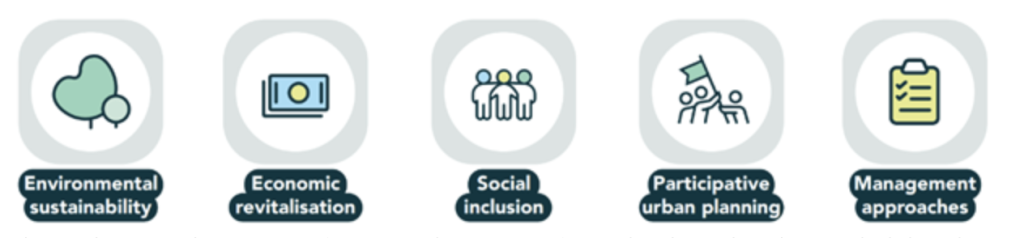
REGEN’s holistic Assessment Framework for Urban Regeneration (AFUR)promotes environmental sustainability, economic revitalization, and social inclusion. AFUR aids stakeholders in achieving decarbonization pathways, enhancing their resilience to climate change through the implementation of targeted regeneration interventions in 4 DEMOS.
Co-designed with stakeholders, innovative participatory processes and digital tool solutions will revitalise underdeveloped areas, enhance the quality of life, and attract new investment.
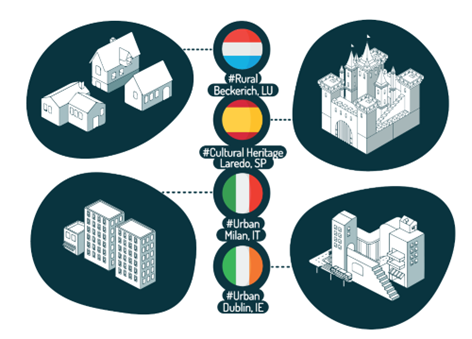
The 4 large-scale DEMOS in Luxembourg, Spain, Ireland, and Italy are led by the municipalities and are directly involved with the local stakeholders as well as other actors from the consortium. Each demo site emphasises a specific typology.
What is a Replication Scenario in REGEN?
10 virtual regeneration projects will be selected to simulate the long-term impacts of regeneration interventions and assess their applicability across the EU. This will strengthen the credibility of REGEN interventions catalogue and provide indispensable information for knowledge transfer on delivering resilient urban regeneration. Regeneration scenarios will be selected to be comparable with the 4 real demo sites’ use cases, in terms of typologies.
2 Replication Scenarios have already been selected in the Netherlands
- Replication 1: Groningen – NL
- Replication 2: Helmond – NL
We are looking for regeneration projects, past or ongoing, which targeted one, or several, of the following domains of intervention:
- 1. Built environment, e.g., interventions to improve the building performances, the quality of infrastructures
- 2. Energy systems, interventions to reduce energy use, and sustainable energy sources
- 3. Mobility and transport, e.g., interventions to reduce vehicle impacts, promote public transportation and active mobility, improve accessibility
- 4. Circular economy, e.g., interventions to improve water and waste management, foster material circularity in the construction sector
- 5. Land management, e.g., interventions to foster greener and healthier urban spaces, as well as related cultural activities)
What do we require from developing the Replication Scenarios?
In order to understand the impacts of your project, a specific description of the implemented/targeted measures will be required, as well as measured/estimated data depending on the targeted domain(s), in particular:
- Cadastral building information
- Energy supply data
- Mobility behaviours and transport specifications
- Waste disposal and recovery scenarios
- Exterior surface data
Any additional information on the environmental and socio-economic impacts (e.g. population characteristics) of the project studied will be considered.
Depending on the domain(s) of intervention of your project and the data you have available, we will be able to propose a number of indicators to assess the long-terms impacts of your regeneration project.
Why participate?
By becoming a Replication Scenario, your regeneration project could:
- Collaborate with Experts: Connect with a consortium of 23 European partners, including research institutions, municipalities, and industry leaders, to share knowledge and best practices.
- Assess the impacts of your sustainable solutions: Apply the Assessment Framework for Urban Regeneration (AFUR) to better understand the benefits and potential drawbacks of interventions and thus promote environmental sustainability, economic revitalization, and social inclusion.
- Support the Community Engagement: The evaluation results can be used as facilitation material within citizen participation activities, to be able to co-design regeneration solutions with rich and transparent information.
- Showcase your project in a LIST’s map server: the Luxembourg Institute of Science and Technology (LIST) developed the iGuess geospatial platform which provides a novel framework for development and implementation based on OGC standards. It uses the WFS, WMS, WCS, and WPS standards. https://iguess.list.lu/
- Capacity building: learn more about different methodologies to measure the impacts of regeneration efforts
Who should apply?
Cities across Europe that are committed to sustainable urban development and are interested in applying REGEN’s assessment methodologies to their local context. Developers with regeneration projects, whether urban, suburban, or rural, if you are facing challenges related to climate change, socio-economic disparities, or aging infrastructure, this opportunity is for you.
How to apply
For more information and to express your interest in becoming a Replication Scenario, please fill out the following form by 28 November: LINK
REGEN is co-financed by the European Commission’s Built4People partnership.
Learn more at Social Innovation Academy
Social Innovation Academy is the first fully online management training programme focusing exclusively on social innovation.
Why Social Innovation Academy? Social innovation has increasingly come to be perceived as the answer to the rising number of European societal challenges. While the European authorities, leading academics, policy experts, business people and activists agree that social innovation is the key to a better future for Europe and the world, it is extremely difficult for professionals to obtain high-quality training on what social innovation actually offers and, more importantly, how it can be done in practice.
The Social Innovation Academy is aiming to change this situation in Europe and beyond. If you are interested in keeping up with this project, you can subscribe to our newsletter, become one of our friends or follow us on social media (LinkedIn, Twitter and Facebook). We welcome all requests for collaboration here.
Graphic and text: REGEN
Subscribe to Social Innovation Academy updates